| |
INTERBID LIVE
Broadcasts an existing auction over the Internet
|
|
People on the Internet can bid as well as those present at the auction.
|
Description
An auction clerk, called the webcaster, who is typically present
at the auction with a computer connected to the Internet controls Interbid Live.
The webcaster relays all the auctioneer's calls to the people on the Internet.
A mouse click or a tap on a touch screen is all it takes to change the lot
or increase the offer price. The connection to the Internet can be as simple as a
notebook computer and wireless broadband or a computer built in to the auction room with
permanent displays for the auctioneer and the crowd.
Increase your turnover
Interbid Live webcasts average 50 people watching on the Internet, with 10% to 40% of goods selling to internet buyers.
But the main reason for offering live online bidding is because sellers love it.
Bid Ladder
Interbid Live incorporates the Bid Ladder that enables bidders to set limits and have
Interbid Live instantly bid for them, up to their limit.
Live audio streaming
The same communication system is used to enable bidders to hear the auctioneer
via Internet audio streaming with the minimum delays.
Computer auctions
Second hand computer auctions have proven an ideal market for Interbid Live.
We have webcast 200 of these auctions with excellent clearance rates and
an average of 25% of lots selling on the Internet.
These auctions tend to be to fast around 140 lots per hour, which Interbid Live can handle readily.
These auctions are ideal for webcasting because they attract computer savvy bidders who are
comfortable bidding on the Internet
and because a computer can be readily bought based on a photo and a description in an
auction catalogue.
General auctions
Interbid Live's dramatic speed advantages means it can be used for a
wide range of auctions.
Interbid Live is the only system suitable for all government and corporate disposal
auctions; it is the best system to can handle fast auctions of computer, catering
and office gear.
The Interbid Live broadcast system is fully portable and can be used for on site
auctions.
Automotive auctions
Again Interbid Lives speed advantages mean it is the best system for
keeping up with car and truck auctions. Increasingly cars are being bought and sold for
interstate markets, Interbid Live can save people having to travel to auctions,
which is very important, these days. Also it enables dealers to bid from their car lots,
rather than take time out to attend an auction. If only dealers should be able to
view or bid at an auction, it is easy to restrict Interbid Live so
the auction is only available to registered bidders.
Art and antique auctions
With Interbid Live there is no need to slow the auction down when people are bidding
from the Internet. Also if people can be encouraged to use the Internet rather than
the phone you can save money on supplying clerks to man the phones and avoid
the auction slowing down when people are bidding over the phone.
There is a version of Interbid Live designed to handle the fixed increment type of
bidding used at art and antique auctions. That is, it can be set for example to
automatically change from $10 increments to $20 at say $200. So to broadcast a call
of $180, $190, $200, $220, $240, etc. all the broadcaster has to do is to keep clicking the
same button.
Real estate auctions
There is a special version of Interbid Live designed for real estate,
with added security in that bidders are required to register for specifically
for each property they wish to bid on. This product is initially available for
in rooms auctions in South Australia but we plan to move quickly to onsite auctions
as well.
Catalogues
Interbid Live is designed to run straight off auction houses existing catalogues
on the web, without the need for any modification. Interbid Live will also find
and use any thumbnail or full size pictures of the lots. In most cases Interbid
Live can pick up all the information it needs to run straight of the auction houses
existing web site.
Dynamic Lot Display
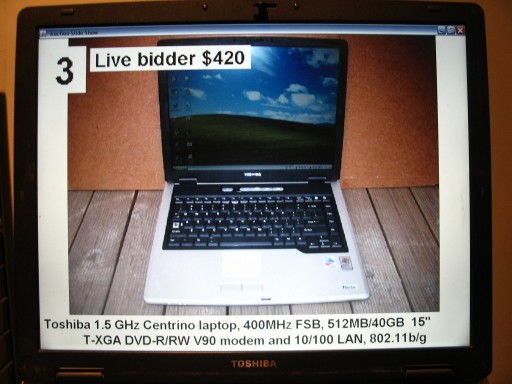
The dynamic lot display runs automatically off the webcast, it displays
the lot number, a picture of the lot, its description and the progression of the
bidding to the people at the auction rooms.
These makes it easier for bidders at the auction to follow the bidding.
Servers
In addition to the program for the broadcaster at the auction, a major part of Interbid Live
runs on a central auction server. This server has to be very well connected
to the Internet and so is generally located at an Internet Service Provider.
Auction houses have the choice of setting up their own servers or renting time
on Interbid's server. Interbid has a server located in Adelaide, South Australia
and plans to install more servers in the near future.
Conclusions
Imagine having an extra row or two of bidders at all your auctions,
the success of online auctioning has proven that people want to bid from
their homes and offices. Webcasting combines the excitement of a live auction
with the convenience of Internet bidding. Webcasting is very attractive to
sellers; it is simply the future of live auctions.